The Real Issue With AI Isn’t the Tool — It’s How You Talk to It
Across Africa, business leaders are discovering the power and frustration of AI at the same time.
One day, it feels like magic — the next day – madness.
From Harare to Johannesburg, managing directors, marketing, HR, IT & Finance heads are all experimenting with tools like ChatGPT, hoping for that “AI edge.” Yet most end up disappointed, saying:
“It’s good, but the answers just don’t sound right.”
That’s not because the AI is broken — it’s because your team is still learning to communicate with it.
AI doesn’t understand what you mean. It understands what you say.
And the difference between a vague request and a well-structured prompt can be the difference between nonsense and strategy.
When AI Gets It Wrong — and Why Prompting Matters
Recently, a top Zimbabwean law firm made headlines after submitting a court document containing AI-generated citations that didn’t exist — the model had simply invented them. It’s embarrassing.
Local experts warned that AI “doesn’t have access to most African legal databases,” so it tries to guess its way through.
This problem — often called AI hallucination — is more likely to happen when prompts are too vague or lack context and guardrails. It’s exactly the problem I unpacked in my earlier post, AI Will Lie to You — Here’s the Fix.
But the real lesson isn’t to fear AI — it’s to learn how to speak to it effectively.
That’s where the RGSW Formula comes in.
The 4-Word Formula That Makes AI Work for You
The RGSW formula stands for
Role, Goal, Soul, Whole — a simple structure that turns generic requests into intelligent collaboration.
It’s not about tricking AI. It’s about teaching it how to think in context.
Let’s break it down.
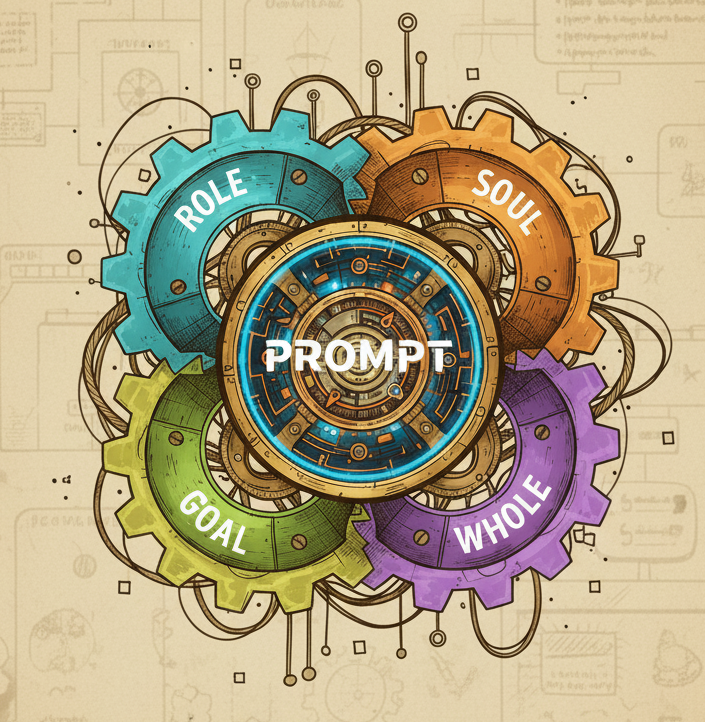
RGSW: Role, Goal, Soul, Whole
1. Role – Who should the AI be?
AI performs best when you tell it who to become.
“You are a South African marketing strategist who understands B2B tech audiences.”
2. Goal – What do you want?
Define the exact outcome or deliverable.
“Develop a three-part campaign outline designed to generate qualified leads for software companies.”
3. Soul – How should it sound?
Specify tone and personality — because style is substance.
“Make it sound sharp and modern, like something from a world-class agency.”
4. Whole – What’s the full context?
Feed the model the world it needs to reason inside.
“Focus on Southern African companies and mention examples relevant to our region. Keep it under 500 words.” Or “Here’s a PDF with our last monthly report so you can understand what went wrong”.
Before vs After: The Power of Four Words
Here’s how the difference looks in practice.
The first column is what most people do. The second is what happens when you prompt like a pro.
| Scenario | Generic Prompt | RGSW Prompt (Improved) |
|---|---|---|
| HR Manager in Johannesburg | “Write an email announcing our new AI training program.” | “You are a corporate communications specialist in South Africa. Draft a short, engaging email introducing our new AI Mastery for Teams program. Goal: inspire curiosity, not overwhelm. Tone: warm, confident, forward-thinking. Context: our staff are excited but uncertain about AI — we want to make it feel empowering, not technical.” |
| Marketing Director in Lusaka | “Give me marketing ideas for 2025.” | “You are a senior marketing strategist based in Zambia. Generate 5 bold, region-relevant campaign ideas for the insurance sector that could capture attention on social media. Goal: position our brand as progressive and trustworthy. Soul: smart, upbeat, with a local touch. Whole: consider current Zambian economic sentiment and the growing consumer interest in security and savings.” |
| Operations Lead in Harare | “Help me improve efficiency.” | “You are a productivity consultant familiar with Zimbabwean SMEs. Outline 3 practical ways we could use AI to save time across our operations. Goal: reduce workload without reducing quality. Soul: concise, professional. Whole: we have a small team, limited budget, and want quick wins that can be implemented in 30 days.” |
It’s not subtle.
The difference is strategy, precision, and tone — all unlocked by four simple words.
The Hard Truth: Great Prompts Take a Little More Effort
Yes — writing great prompts takes a few extra seconds of thought.
You have to clarify what you want, define tone, and provide context.
But that’s exactly why it works.
AI rewards clarity, ambition, and direction.
The best results don’t go to those who dabble with AI — they go to the ones willing to think, guide, and experiment.
The truth is, AI isn’t for the lazy — it’s for the ambitious.
It’s a tool for people who want to multiply their output, not avoid effort altogether.
How to Use It in 3 Minutes
Here’s a quick template you can start using today:
You are [ROLE].
Your task: [GOAL].
Tone/style: [SOUL].
Context and boundaries: [WHOLE].
Try it once.
Then refine it.
Then teach it to your team.
That process — not the prompt itself — is where the power lies.
Why This Matters for Teams
When leaders and teams learn how to prompt well, AI becomes a real productivity partner.
Meetings move faster. Reports come back clearer. Content improves.
It’s not magic — it’s communication, done right.
The next step isn’t to ask “What can AI do for us?”
It’s to ask, “What can we achieve once we know how to ask it properly?”
Want Help Putting This Into Practice?
If you’d like to equip your team with practical AI skills or use AI to supercharge your marketing, fill in the quick form below.
Just type:
- 🧠 “Training” if you’re interested in corporate AI workshops
- 🚀 “Marketing” if you’d like to implement AI for real business growth
We’ll reach out to design the right plan for your organization.
About Max Soutter
Max Soutter helps businesses across Africa leverage AI to get more leads and customers — and get more work done, faster.
Through both corporate AI training and hands-on marketing implementation, he helps organizations move from theory to tangible results.


 Max Soutter
Say something!